Conference

Click to see our recorded Keynotes!
Download the SLAS 2026 Programme
Between 9-10th April 2026, SLAS returned to the University of Leeds, where it last took place in 2009.
 Based on the theme of Memory Studies and Social Justice, our panels intersected with memory studies through themes such as extractivism and environmental justice; the rights of nature and planetary agency; the politics of memory, post-memory and memorialisation; state-building and democratic transitions; digital memory studies and archival futures.
As well as our four Keynotes, the conference included an exhibition of student research posters and original artworks, film and documentary screenings, and a performance.

Understanding the financial challenges faced by students, postgraduate researchers and early career academics, we made our best efforts to make this conference as accessible as possible. First, the Welcome Event in the evening of 9th April was included in the ticket price, making sure every attendee gets the chance to join the celebrations and network with the SLAS community, as well as to listen to some superb live music. Second, for PILAS members unable to attend the full event, a low-price ticket to the welcome event was made available. And, third, we opened all of the keynotes to the public.
To support these initiatives, we created a new ticket category for higher earners and anyone with the means to purchase a slightly higher-priced ticket. In solidarity for our earlier career colleagues, we ask that those who can to please select this category.
There will also be a reduced conference registration fee for SLAS members, find out how to join here: MEMBERSHIP
And finally, remember to check the SLAS website for details of available funding: FUNDING
Programme Highlights
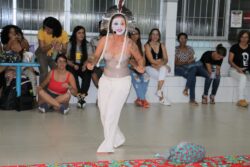
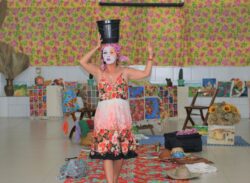
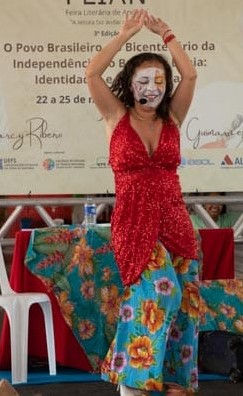
Performance: Sertões Contemporâneos, organised by Gislene Moreira
Friday 10th April 10.45-12.00
The theatrical performance "Sertões Contemporâneos" is the result of the academic research of the same name that discusses social, political, cultural, and communicative transformations in the semi-arid region of Bahia. The initiative provides a musical and scenic immersion through a century of modernization and the impacts of globalization on female bodies. The performance discusses how changes in rhythms, styles, and aesthetics in the hinterland of the backlands reflect profound and complex shifts in power relations. The theatrical performance blends theoretical depth with humor and dance to provoke critical reflections on the construction of memory and spaces through female bodies. The body-territory-performance is the methodological application of decolonial studies and provokes ruptures and impulses of resistance. The initiative has already toured more than 20 cities, performing at street markets and cultural spaces, reaching an
estimated audience of 15,000 people. After the presentation, which lasts approximately 30 minutes, there will be time for dialogue and exchange with participants about the emotions, historical processes, concepts, and methodological contributions that led to the work. There will also be the launch of the book "Munturo," a literary novel that also rewrites the sertões from the perspective and actions of women.


Confirmed Keynotes:
Leslie Wehner is Full Professor and Chair of International Relations at the University of Bath. He is currently Chief Editor of Foreign Policy Analysis and past Vice-President of the International Studies Association (2021-22). Leslie Wehner’s research interests include theories of foreign policy analysis, International Relations theory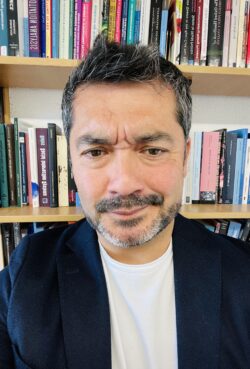 and international political economy. He also conducts research on role theory in foreign policy, emerging powers (BRICS), leaders and leadership in foreign policy analysis, populism in international politics, and regional cooperation and trade strategies of Latin American states. His most recent work has been published in British Journal of Politics and International Relations, Cambridge Review of International Affairs, Cooperation and Conflict, Foreign Policy Analysis, Gender & Politics, Global Studies Quarterly, International Studies Quarterly, International Studies Perspectives, International Studies Review, International Relations, & Journal of International Relations and Development.
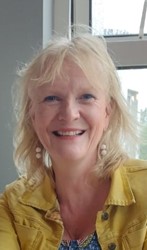
Nuala Finnegan is Professor of Spanish and Latin American Studies at University College Cork, Ireland. Director of the Centre for Mexican Studies (1999-2023), she has published widely in the areas of contemporary Mexican literary and visual cultural studies with a particular focus on gender. Much of her work explores cultural interventions on violence like, for example, Cultural Representations of Feminicidio on the U.S.-Mexico Border (2018), as well as exhibitions, community engagement and student/staff cultural activism. Committed to multi-disciplinary collaboration, she has extensive experience of exhibition curation and co-ordination including OUTPOSTS: global borders and national boundaries Involved in exploring the generative interconnections between Ireland and Latin America, she recently led a research team with Ulster University on an award-winning project called Critical Epistemologies Across Borders (2022-25), which integrated Latin American art practice and feminist epistemological approaches to forge conversations about women, identity and new constitutional futures on the island of Ireland. She is currently working on a project on ethics, politics and child-centred art practice at the Mexico-US border and her latest book is Changing Configurations of Día de Muertos during the COVID-19 Pandemic, co-authored with Jane Lavery (Palgrave 2025).

Katucha Bento. I am a Black Brazilian woman, teacher, creative writer, poet, Black queer feminist, antiracist disruptor, decolonial activist, auntie, PhD in sociology and social policy, and a vegan foodie. Currently, I serve as a Senior Lecturer in Race and Decolonial Studies and Chaplain in Candomblé at the University of Edinburgh (UoE). I am also the co-founder of the Free Afro-Brazilian University (UNAFRO), a third sector collective to offer accessible education to all people as part of reparative justice. My work is dedicated in discussing Black diasporic experiences and interlocking oppressions involving the lives and routes towards liberation, radical love and how affect circulates, topics I discuss in my upcoming book “Intersectionality in (post)colonial Britain: Weaving affect with Black diaspora” (Palgrave, 2026).

Guilherme Wisnik is a tenured professor and Vice Dean of the Faculty of Architecture and Urbanism at the University of São Paulo (FAU USP). He is the curator of the Brazilian Museum of Sculpture and Ecology (MuBE). He was the chief curator of the 10th São Paulo Architecture Biennial (2013), of the exhibition Infinite Span: 90 Years of Brazilian Architecture (Casa da Arquitectura de Portugal, 2018), and of the Brazilian Pavilion at Expo 2020 in Dubai. He is the author of books such as Lucio Costa (2001) and Inside the Mist: Contemporary Art, Architecture and Technology (2018). He received the “Prominence 2018” award from the Brazilian Association of Art Critics.
Sponsors: The School of Languages, Cultures and Societies; The Centre for Global Development (POLIS); The Cervantes Institute; the Instituto Guimarães Rosa and British Council.